Misprints: How LEGO®'s mistakes created their own market.

Updated: Oct 17

A 501st downshift misprint from BTBricks' misprint collection
So, what is a LEGO® Misprint?
Manufacturing errors have existed since manufacturing itself, but few are as collectable as LEGO® misprints. Hence the name, a misprint is an error or mistake during the printing process of a LEGO® piece. Misprints can happen in many ways, but are generally caught by quality control and intercepted before appearing in a set. Despite LEGO's famous motto 'only the best is good enough', misprints still occasionally surface in LEGO® products. Due to their rarity and unique-looking appearance, many collectors seek out misprints to add a fun touch to their collections. While there are numerous types of misprints, here is a brief summary of the 5 most common ones:

90 Degree Captain Rex

Color Swap Spiderman

Overlapped Boba Fett
Types of Misprints:
1. Shifts
Print shifts are the most famous and prevalent type of misprint, featuring exactly what the name describes, the printing being shifted into an unintended position, most commonly downwards or laterally. The shifts can be as minor as a few degrees left or right, all the way to a complete 180º reversal, known simply as a 180. Even more rare, a 90º rotation is also possible.
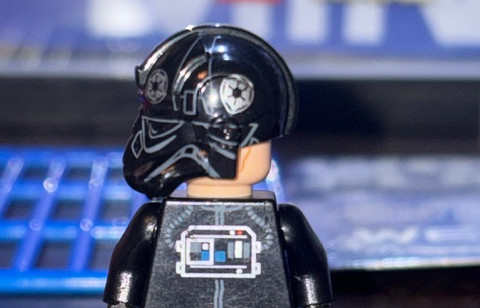
Nearly 90 Degree Tie Pilot

Shifted face print on a knight

Shifted Forestmen
2. Color Swaps
As the name describes, parts can occasionally appear printed on the wrong color. This phenomenon is most common in heads, yet also occurs in torsos and legs. It is important to clarify that in nearly all cases, color swaps will only occur in colors that said part is currently manufactured in. This means that a part such as a clone trooper's helmet will not be printed on a color like pink, considering that is a non-production color for that piece.

Color swap on Hut Tub Stormtrooper.

Color swap on Vintage Knight

Combination of color swap and print stage (see next) on the Mandalorian.
3. Print stages
Like the other types, print stages are also self-explanitory. Print stages occur when a part receives only certain colors of printing, but not others. Since LEGO® prints one color at a time, it is possible to find pieces that have only been printed with a few of the total colors. Because LEGO® prints generally require a layer of primer, it is also possible to find stages with primer only. In very rare scenarios, print stages can be found in combination with color swaps to create a part that is both missing print and printed on the wrong color.

A Lobot figure missing the black bring stage.

A Chima Lion with only the white stage

Every print stage for the the landspeeder Smart tile
4. Multiprints
Multiprints are also just that, multiple prints on the same piece. These can be found in a few forms: Parts with one character's design on one side and another's on the other (torsos, heads), Several different designs atop one another on one piece (known as layer prints), and the same print printed several times over. The latter is most common in older Minifigures (~pre-2006), whereas the former 2 are more common in newer figures (~ post-2006)

Chima and City face overlap

Spider-Man and Firefighter overlap

Clone Trooper and City Overlap
5. Partial prints
Partial prints are a strange and divisive kind of misprint for a couple reasons. To describe what the are, they occur when a printing stamp only prints part of a color/layer. It is disputed how or why these kinds of misprints occur, Because some older Figures such as the Classic Boba Fett, split printing between 2 pads, only half of a print is possible, though there is no concrete explanation for more recent figures. When these errors happen, the print that remains is often skewed, altered, or abnormal in some way (see photos). However, the most important and dividing aspect is that fake partial prints can be created with relative ease. By simply erasing a section of print either physically or chemically, one can claim to have received a partial print. This method, while frowned upon and dishonest, does occasionally occur. This often discourages the sale of real partial prints, leading to an small and mostly private market.

A half-printed phase one clone trooper

A half-printed Boba Fett

Deadpool Missing Leg print
Finding Misprints:
Seeking out misprints is as easy or complicated as you make it. For somebody wanting to begin collecting misprints or solely seeking one / a few, public marketplaces like eBay, Bricklink, Whatnot, and Facebook marketplace have plenty of less rare options. While it is possible to find extremely rare misprints on public selling sites, it is quite rare and may cost you more than is reasonable to most. At any given time, a platform like eBay will have a fair selection of color swaps, stage prints, and possibly a couple shifts, though affordable shifts generally sell extremely quickly. Finding rarer misprints like the examples below often comes down to a large time commitments, luck, or simply knowing the right people.
Cost:
The monetary aspect of misprints is perhaps the most strange and convoluted. Since they are inherently non-distributed items, the prices are generally more arbitrary than concrete. Some more common misprints with several copies available / known of can have market values, whereas the rarer misprints generally boil down to whichever customer has the deepest pockets. This is not to say that there is no market value, rather that it takes a lot of experience to understand how the market behaves.
Because each misprint depends on several independent factors, the values can vary drastically. For example, a noticeable downshift on a common star wars figure can fetch anywhere around 100-200 USD, while a less significant shift on a figure like Captain Rex (2013) often sell from 500 to even 1,000 dollars. Star Wars misprints tend to fetch a premium, with other popular themes like DC, Marvel, and Castle trending higher as well. Adversely, less desirable themes like Dreamzzz, Chima, and City can generally be found more affordably. Some of the most common misprints in undesirable themes like city can occasionally be found for under 20 dollars. The lesson you must learn is that the seller dictates the price. The only way to truly determine a "good price" on a misprint is to decide whether it's worth it for you. Keep in mind, a $300 misprint for one may only be worth $30 in the mind of another.


Comments